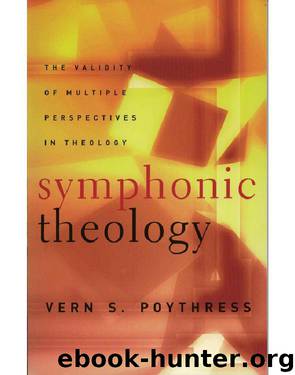
Symphonic Theology: The Validity of Multiple Perspectives in Theology by Vern S. Poythress
Author:Vern S. Poythress
Language: eng
Format: mobi
Tags: Religion, Systematic, Christian Theology
ISBN: 9780875525174
Publisher: P&R Publishing
Published: 1986-12-31T22:00:00+00:00
7: TWELVE MAXIMS OF SYMPHONIC THEOLOGY
It is now time to summarize some of the basic principles involved in a symphonic approach to doing theology. I express these principles here in twelve maxims.
1. Language is not transparent to the world.
Natural human languages are not simply perfect, invisible glass windows that have no influence on what we see in the world. Nor is there a perfect language available that would be such a perfect window. In particular, no language will enable us to state facts without making any assumptions or without the statements being related to who we are as persons. No special language can free us from having to make crucial judgments on the basis of partial analogies or similarities. No special language can immediately make visible to us the ultimate structure of categories of the universe.
Positively, natural languages are adequate vehicles for human communication and for communication between God and human beings.[1] Some of the features that might be supposed to be imperfections are in fact positive assets. In the Bible God uses ordinary human language rather than a technically precise jargon. He does not include all the technical, pedantic details that would interest a scholar. By doing so, he speaks clearly to ordinary people, not merely to scholars with advanced technical knowledge. What God says is not exhaustive, but it is sufficient to save us and to provide a sure guide for our life.
Hence, the ordinary, humble readers of the Bible do all right. Paradoxically, scholars and would-be scholars can easily get into trouble by overestimating the degree of technical or pedantic precision in the Bible. They will then fall into mistakes that an ordinary reader of the Bible would not make. Therefore, if we are engaged in more scholarly theological reflection, we must become self-conscious about our language. Of course, most scholars do not explicitly do theology on the basis of some fully developed philosophy of language. Mistakes made without an explicit philosophy are nevertheless mistakes. And such mistakes do occur. In fact, mistakes, obscurities, inadequacies, and infelicities related to language occur with considerable frequency in our day, even in reputable, scholarly writings of theology.[2]
James Barr has published a long catalog of mistakes made by biblical scholars. Without going into detail, I list six of the most common errors that he cites.[3]
Attempts to deduce theological conclusions directly from the grammatical structure of a language. For example, Thorlief Boman tries to deduce a philosophical concept of time from the Hebrew tense system (pp. 79-81).
Attempts to deduce theological conclusions directly from the number and relation of vocabulary synonyms. For example, Edmond Jacob attempts to deduce the fluidity of the concept of miracles from the fact that several different terms are used (p. 147).
Attempts to use etymology instead of the current meaning of a word, even when the current meaning is well known. For example, “holy” and “healthy” are etymologically related, but they do not now mean the same thing, and it is just confusing to say that they do (p. 111).
Download
This site does not store any files on its server. We only index and link to content provided by other sites. Please contact the content providers to delete copyright contents if any and email us, we'll remove relevant links or contents immediately.
The Secret Power of Speaking God's Word by Joyce Meyer(3165)
Signature in the Cell: DNA and the Evidence for Intelligent Design by Stephen C. Meyer(3124)
Real Sex by Lauren F. Winner(3006)
The Holy Spirit by Billy Graham(2941)
The Gnostic Gospels by Pagels Elaine(2522)
Jesus by Paul Johnson(2351)
Devil, The by Almond Philip C(2324)
23:27 by H. L. Roberts(2245)
The Nativity by Geza Vermes(2226)
Chosen by God by R. C. Sproul(2159)
All Things New by John Eldredge(2157)
Angels of God: The Bible, the Church and the Heavenly Hosts by Mike Aquilina(1952)
The Return of the Gods by Erich von Daniken(1927)
Angels by Billy Graham(1920)
Knowing God by J.I. Packer(1850)
Jesus of Nazareth by Joseph Ratzinger(1802)
The Gnostic Gospel of St. Thomas by Tau Malachi(1781)
Evidence of the Afterlife by Jeffrey Long(1776)
How To Be Born Again by Billy Graham(1775)
